Everyone is counting the tokens. Count the fees#
On Tuesday night Brian Armstrong posted that “all asset classes are moving onchain,” with a Blockworks chart showing $3.75 billion of tokenized stocks across 1,501 tickers. The next morning, DTCC switched on its tokenization service. On the Milk Road Crypto episode above, Kyle Reidhead said the market was already “close to 5 billion” and that more stocks on chain means the earning potential for DeFi protocols “just goes up massively.”
He’s right about the direction. But the question I care about, as someone who trades this stuff, is narrower: when Wall Street moves on chain, who actually gets paid? And what do you own when you hold the token?
Short answer: the money so far goes to the plumbing. Issuers, custodians, brokers and the venues that match the trades. And most holders own a claim on a company that holds the stock, not the stock.
First, how big is it really?#
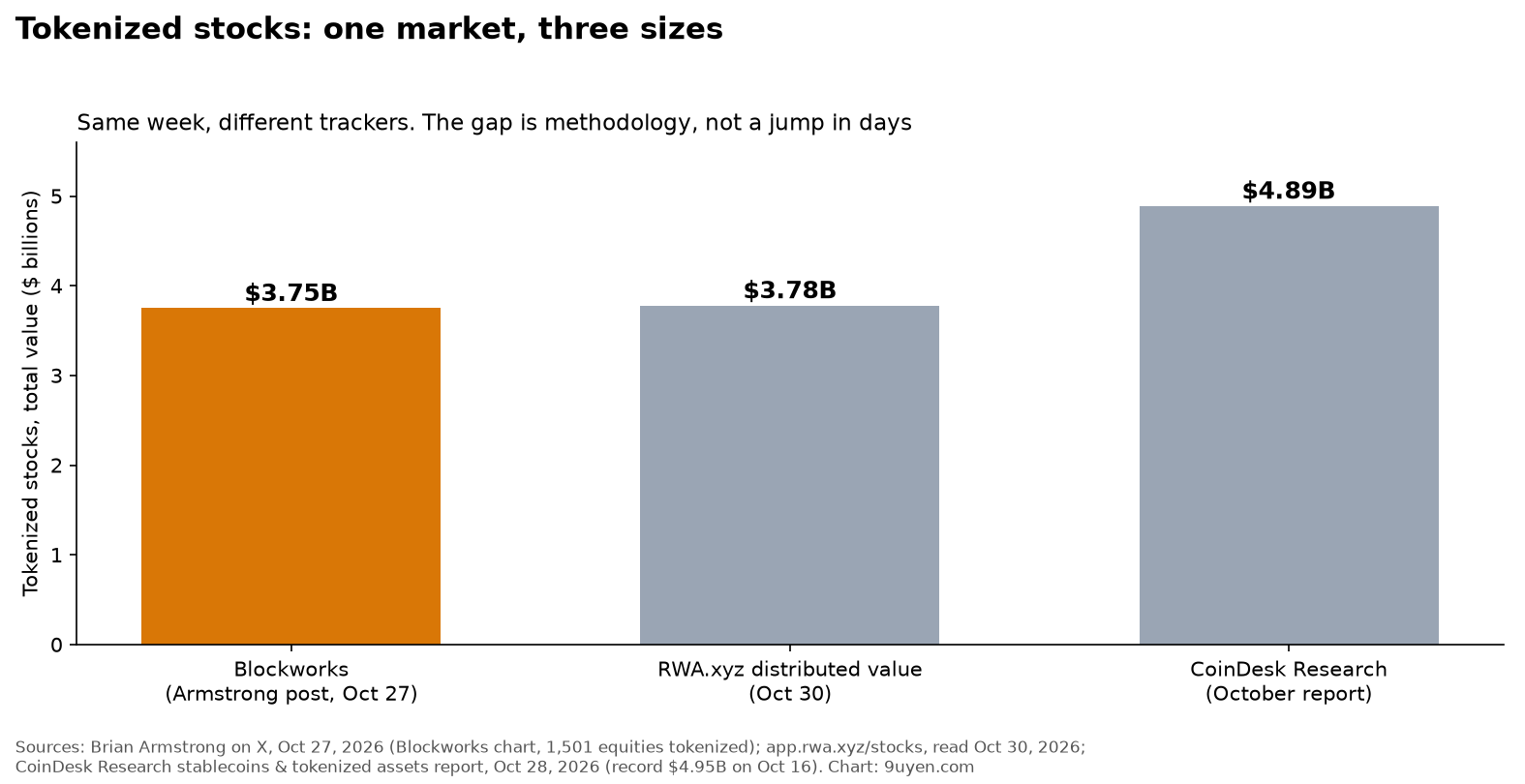
The “from $3.75 billion to $5 billion in days” story doesn’t hold up. Those are two different rulers. Blockworks, the source in Armstrong’s post, says $3.75 billion. RWA.xyz shows $3.78 billion of distributed value this morning, up about 17% in 30 days. CoinDesk Research’s October report counts more and lands at $4.89 billion, just under its own Oct. 16 record of $4.95 billion.
The billion-dollar mint Kyle mentioned is real too. It was over $1 billion of Binance’s token for the GraniteShares 2x Long Marvell ETF, minted over a recent weekend, as ARK Invest flagged on Oct. 26. But it came before Armstrong’s post, so it’s already in his number. One leveraged ETF token is a big slice of this market. That tells you how small the market still is, not how fast it’s growing.
So call it $4 to $5 billion, depending on who’s counting. That’s tiny next to the roughly $30 trillion of securities DTCC says are eligible for its new service at launch. Which is why the fee question matters now, before the volume shows up.
Who issues the tokens, and what they charge#
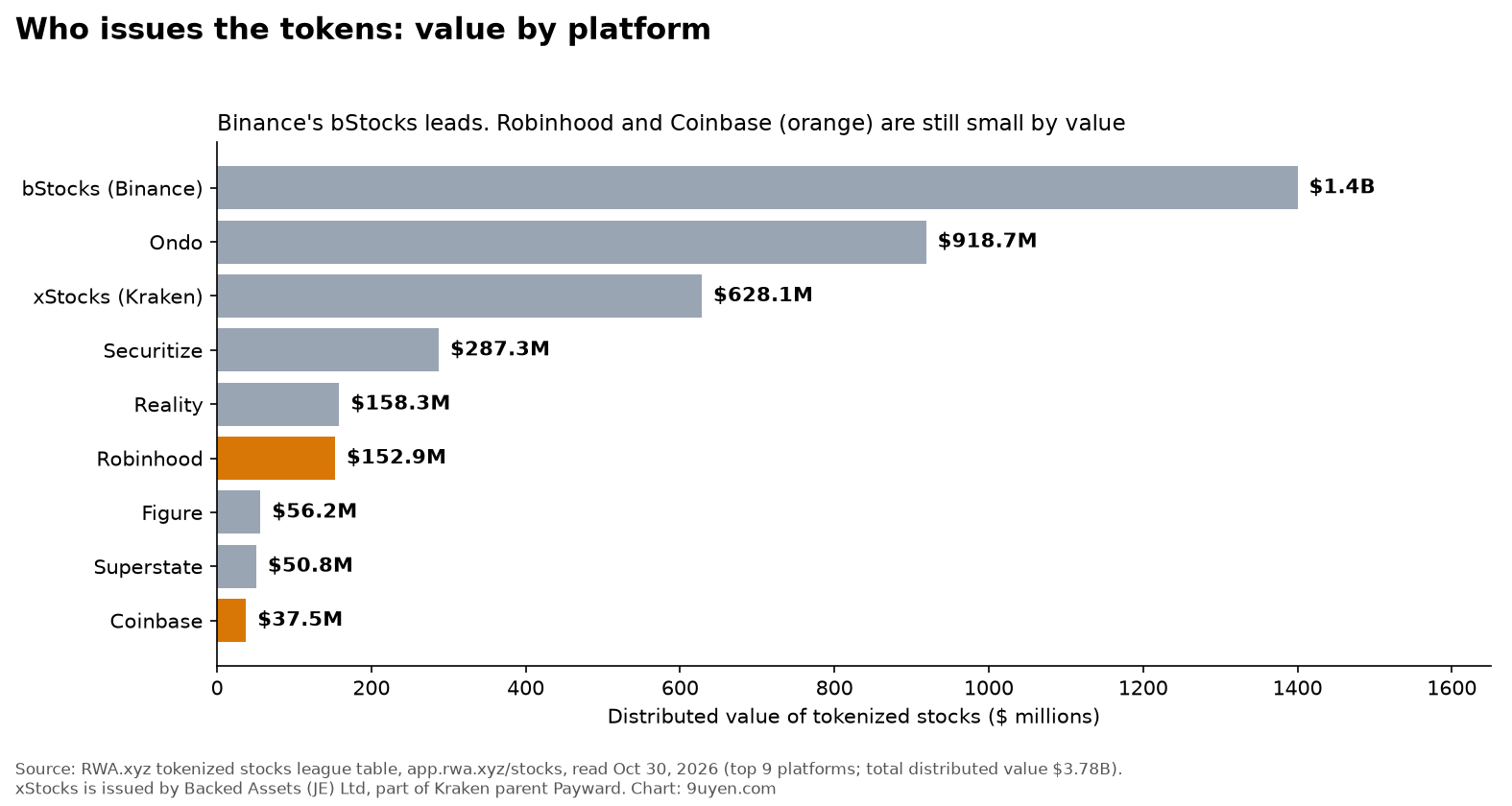
The biggest issuers are not brokers you know. Binance’s bStocks leads on RWA.xyz at about $1.4 billion, then Ondo, then xStocks. Robinhood and Coinbase, the two names in every headline, hold a fraction of that so far.
Each one makes money in a different place:
- Coinbase spells it out. Its ADGM prospectus for one token lists a 0.01% creation fee, a 0.05% redemption fee, and a 5% cut of every dividend, taken before withholding tax. That last one is the quiet one. On a dividend stock, it’s a permanent skim for as long as you hold.
- Robinhood in the EU charges a 0.10% currency fee each way and nothing else, per its fee schedule. Robinhood Europe is the other side of every one of those contracts, so the trading itself is the business. That’s also why it led onchain stock trading volume in September, per CoinDesk, while holding far less value than Binance.
- Binance and Kraken own the venues where bStocks and xStocks trade. A token that is cheap to hold still pays the exchange every time it changes hands.
Then there’s the layer under all of them. Coinbase’s token and Binance’s bStocks both keep the real shares at the same place: Alpaca Securities. Alpaca is also one of the 20 firms signed up for DTCC’s service, next to JPMorgan, Citadel Securities and Morgan Stanley. A broker most retail traders have never heard of is now custody for two of the biggest token issuers. That is what “the money goes to the plumbing” looks like in practice.
What you actually own#
This is the part I wrote about with Ondo two weeks ago, and it’s worth repeating because the structures are all different:
- Ondo: a note from a British Virgin Islands company. Per its docs, “you do not have shareholder voting rights.”
- xStocks: a tracker certificate from Backed Assets (JE) in Jersey. No voting rights under the terms, though Broadridge now lets eligible holders send voting preferences for the shares behind some tokens.
- Robinhood EU: not a security over shares at all. It’s a derivative contract with Robinhood Europe. The key information document says “holding the Product does not mean you own any shares,” and if Robinhood Europe goes insolvent, you can lose some or all of your money. No investor compensation scheme covers it.
- Coinbase: a beneficial interest in shares held in trust. Better, but only “Vested Holders” who pass KYC can vote or redeem. If you bought the token on a DEX and never verified, the prospectus says you have no rights you can exercise, and the issuer can freeze or blacklist tokens at the contract level.
- bStocks: an interest in shares held by BTech Holdings, a Binance affiliate in Abu Dhabi. Binance says it’s not direct ownership, and there are no voting rights.
Every one of these says “backed 1:1.” That’s about collateral. It tells you nothing about whether you can vote, whether you get the full dividend, or who you’re exposed to if a company in the middle fails.
DTCC changes the deal#
The DTCC launch on Oct. 28 is the real story. It’s a different model. Big brokers turn shares already held at DTC into tokens on Canton or DTCC’s private Besu network, and DTCC says those “digital twins” keep “the ownership rights, investor protections and economic entitlements” of the original shares. It starts with 34 eligible securities: large Russell 1000 stocks, index ETFs and Treasuries.
That’s the version where the token is the stock. It’s also the version where the old gatekeepers keep their seats. You get in through a DTC participant, wallets have to be on an approved list, and conversions run on business hours. Only the transfers run 24/7. If this model wins in the US, the fee pool stays mostly with the custodians and broker-dealers that run it today. DeFi gets the assets later, through whoever those brokers let in.
Galaxy is the plumbing trade, with an asterisk#
The hosts spent the first part of the show on Galaxy, which sells exactly this kind of plumbing to institutions. The Q3 release does show $323 million of net income, so the “$300 million-plus profit” line checks out.
Look at where it came from, though. Of $569 million in adjusted gross profit, $419 million sat in Treasury & Corporate, which is mostly gains on its investments. The Digital Assets business, the trading and services side that should benefit from tokenization, did $71 million of adjusted gross profit and $9 million of adjusted EBITDA. Martin said as much on the show: most of the beat is the crypto book being repriced. The $6.6 billion the hosts cited matches Galaxy’s $4.9 billion of cash, stablecoins and Treasuries plus $1.7 billion of net digital assets and investments. Galaxy also just issued $3.5 billion of senior secured notes to build out its Helios data center campus, so that cash isn’t all spare.
Where I land#
Full disclosure: I trade equity perps on Hyperliquid. That’s a third kind of “onchain stock.” No share is held anywhere. It’s a contract priced off the stock, and on HIP-3 markets the deployer can keep up to 50% of trading fees, per Hyperliquid’s docs. Yesterday the NYSE’s parent agreed to operate a regulated US retail version of Trade[XYZ]’s Hyperliquid markets, which I covered in today’s Digest. The venue earns on every trade, whether you hold the stock or just the price.
Martin made the point on the show that worries DEX holders most. If market makers move on chain and quote their own prices, buyers will just take whoever fills them best, “they will keep some small fee and that’s it.” That’s the bet in one line. Tokenized stocks will grow. The fees go to whoever controls custody, redemption and order flow. Right now that’s Alpaca, DTCC’s members, Binance and Robinhood, more than any DeFi token.
What I’d do with this:
- Read which structure you’re holding. Note, certificate, derivative, trust interest or a real DTC token. Each one fails in a different way.
- Check the dividend math. A 5% cut of dividends on top of up to 30% US withholding for non-US holders adds up on income stocks.
- Verify before you hold on a DEX. For some issuers, an unverified wallet holds the price and none of the rights.
- Follow the custodians, not the tickers. The names that keep showing up under the products are the ones getting paid either way.