Credit: this is my take on Ondo Hit $1 BILLION in 8 Months - What Comes Next Is Even Bigger, a 41-minute Milk Road episode released October 16, 2026. Host John Gillen interviews John Hoffman, managing director and head of product portfolios at Ondo Finance. Quotes are Hoffman’s. The opinions are mine.
Video: Milk Road, with Ondo’s John Hoffman. Recorded October 15, released October 16, 2026.
The short version#
Ondo says it now holds more than $4 billion across its tokenized products. More than $1.3 billion of that is tokenized US stocks and ETFs, and it has passed 1 million cumulative holders. Its stock platform launched in September 2025 and crossed $1 billion in under eight months, per Ondo.
That speed is real. So is the catch. When you buy Tesla on Ondo, you don’t own Tesla shares. You own a structured note from a British Virgin Islands company that tracks Tesla, backed by real shares held at a US broker-dealer. No votes. No shareholder rights. And no access at all if you’re a US person.
Hoffman says that openly in the interview. Most people buying these tokens on an exchange have never read it.
Why this is moving so fast#
Hoffman spent nearly 20 years at Invesco, including running its Americas ETF business, then led distribution at Grayscale. He joined Ondo in June. His whole frame is that tokenization today looks like ETFs in the early 2000s: mocked, misunderstood, then everywhere.
His growth comparison: stablecoins took about three years to reach $1 billion, tokenized treasuries about 18 months, Ondo’s stocks about eight. Those first two numbers are his, not mine, but the direction matches everything else in this market.
He gives two reasons. The product is borderless, so the addressable market is anyone with a wallet. And younger investors inheriting money trust apps more than branches. I’d add a third: for someone outside the US, getting clean exposure to Nvidia or the S&P 500 through a local broker is still slow, expensive, or blocked. A token on Binance or in MetaMask is not.
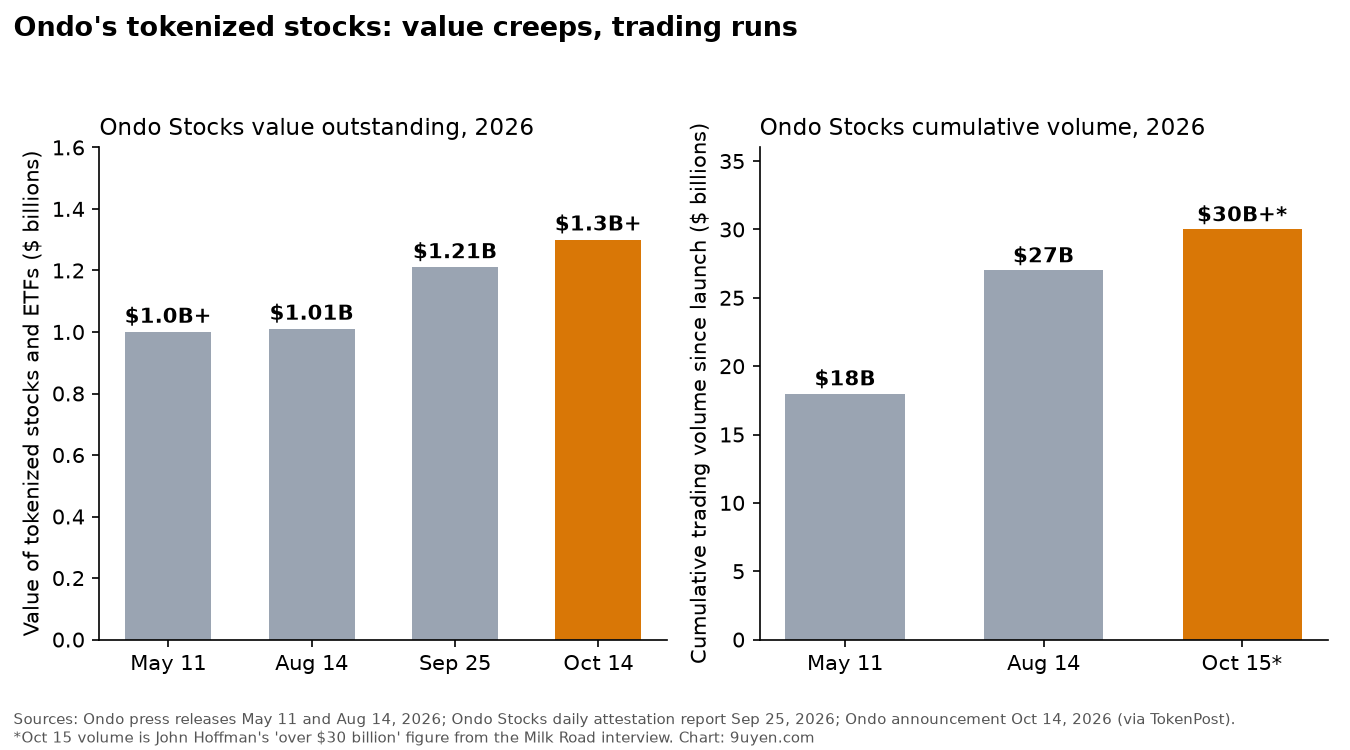
Look at the right side of that chart. Value outstanding barely moved between May and August. Cumulative trading went from $18 billion to $27 billion in the same three months, per Ondo’s own releases, and Hoffman puts it over $30 billion now. People aren’t just parking money in these tokens. They’re trading them, a lot.
What you actually own#
Gillen asks the right question with a good example: a taxi driver in Brazil buys Apple on Ondo. What does he own?
Hoffman’s answer: the buyer sends stablecoins, Ondo buys a real Apple share, and the buyer gets a token that “seeks to provide the economic return of Apple stock.” A third-party trust company checks the account and publishes a daily attestation. Ondo’s September 25 report, verified by Ankura Trust, shows about $1.21 billion of stock tokens outstanding against assets at 106.64% of obligations.
Ondo’s legal docs spell out the rest. Each token is a debt instrument issued by Ondo Global Markets (BVI) Limited, governed by Swiss law. Holders can redeem for the value of the underlying and have a first-priority security interest in it. They do not get “shareholder voting rights, shareholder information rights or other shareholder rights.” Tokens are sold only under Regulation S, to non-US persons.
Hoffman’s read is that this is fine: “it doesn’t have all of the rights,” but fast adoption shows plenty of people want the economics without them. He’s probably right about demand. But it changes what “tokenized stocks” means. This is closer to a well-collateralized tracker than to owning a slice of a company.
The IMF’s warning, and Hoffman’s answer#
The IMF’s October Global Financial Stability Report looked at the five most actively traded tokenized US equities across 11 venues over a year. Its findings are worth knowing before you trade these:
- Tokenized equities were about 1.5× as volatile as the same stocks on traditional venues.
- More than half of trades happened outside US market hours. About 80% were for less than one share.
- Liquidity was thinner on centralized exchanges and thinnest on decentralized ones, where prices strayed further.
- On average, prices still tracked the underlying stock closely.
Hoffman’s response is that the IMF lumped different models together. Ondo routes trades into traditional market liquidity, so its tokens stay pinned to the real price. Other models, he says, “decouple” at times and swing harder. That’s a fair distinction, and also exactly what the issuer with the biggest market share would say. The IMF’s own point stands: some of that extra volatility is just what happens when a stock trades at 3 AM on a Sunday with nobody making markets.
I trade onchain equities myself, on Hyperliquid’s builder-deployed perp markets. That’s a third model again: no share held anywhere, just a perpetual contract priced off the stock. Different risks, different rules. The word “tokenized” is covering a lot of very different products right now.
The US door opened, but not for this product#
Here’s the part I think gets missed. After the CLARITY Act failed a Senate cloture vote on September 15, the SEC issued its five-year “Innovation Exemption” on September 17. It lets new tokenized securities venues trade tokenized US stocks onchain.
One condition: the venue must verify the token gives holders “the same rights and privileges” as the traditional share. Ondo’s current tokens, by their own docs, don’t. So the product that got Ondo to $1.3 billion offshore is not the product that walks through the new US door.
Hoffman says Ondo already has a broker-dealer, transfer agent and investment adviser in place, and won’t launch in the US until it can offer something better than a “replatforming” of what exists. Ondo has also confidentially filed a registration statement with the SEC for transferable tokenized stocks. Read together, my guess is a US version that looks different: real shares, real rights, permissioned venues.
What comes next: portfolios as tokens#
The newest piece is Ondo Intelligent Portfolios, launched September 24. One token holds a whole basket that rebalances automatically. Seven exist today. Three follow strategies BlackRock developed for Ondo: High Income, Diversified Growth and High Growth. The other four are Ondo’s own, including MAG7X, which holds the Magnificent Seven plus tokenized Bitcoin and Ether ETFs.
Hoffman calls it “the SPY moment” for tokenization, the plain index product that has to exist before leveraged, active and thematic versions can follow. He expects active strategies, more managers, and baskets that mix in perps, options and prediction markets. One detail matters: BlackRock designs the model, but per Ondo’s docs it doesn’t issue, manage or custody anything, and has no obligations to token holders.
What I’d do with this#
- Read the issuer page before you buy. Note, wrapper, perp, or real share: each one fails differently. “Fully backed” is about collateral. It says nothing about your rights.
- Treat weekend prices as thin. The IMF data says off-hours trading is where volatility lives. Don’t size a position as if a Sunday quote is a Nasdaq quote.
- Watch the US structure, not the headlines. The SEC exemption favors tokens with full shareholder rights on permissioned venues. Whoever ships that first gets the US market. Ondo has the licenses. The question is whether it rebuilds the product to fit.
- Don’t confuse growth with maturity. $1.3 billion is huge for onchain and tiny for equities. Hoffman’s own ETF comparison cuts both ways: ETFs won, but it took decades.
Hoffman’s line from his ETF days fits: “if you don’t like change, you will hate irrelevance.” Fair. Just know what you’re holding while the change happens.
Sources#
- Milk Road: Ondo Hit $1 BILLION in 8 Months (video)
- Ondo: $1B TVL release, May 11 (Ondo blog version), milestones release, Aug 14, daily attestation report, Sep 25, legal structure, Intelligent Portfolios launch, portfolio list, model providers, John Hoffman hire
- TokenPost: Ondo passes $4B TVL
- IMF: What Is Needed for Tokenization to Deliver, GFSR October 2026, Chapter 3
- CoinDesk: IMF on tokenized stocks
- Decrypt: IMF findings
- SEC: Innovation Exemption order
- CNBC: CLARITY Act cloture vote fails
- The Block: Ondo BlackRock portfolios