The offer#
Greg Isenberg had Nick, a co-founder of Orgo, on the show this week to lay out a business: build a custom team of AI agents for one company, charge “$25,000 upfront,” then keep the client on “like 3,000 a month” to maintain it.
The demo is good. Nick built Bops, a team of bots where each one has its own computer with four screens, an email address and a phone number. He calls his chief-of-staff bot from his phone, asks it to pull up a list of companies to sell to and watch Hacker News, hangs up, and it goes to work. He says he built it in a weekend, in one long 36-hour coding thread.
Then comes the pitch to the owner. Greg plays a dentist and asks the obvious question: how does this make back the money? Nick’s answer is the front desk. Ask what the person doing email, billing and bookings costs, which he expects the owner to put at $50,000 to $70,000 a year, then point at the bot doing that job. “That’s just one of the 15 people, 15 bots that I’m giving you here today.”
That answer is why the price sounds reasonable, and it’s also the part I’d push back on hardest.
What the $25,000 is not paying for#
Bops is public. Its README lists the hosted plans: free, $20 a month, and $200 a month on Max, which includes $200 of AI credit and up to three computers. So a year of the top plan runs $2,400. The custom offer, with a year of retainer, runs $61,000.
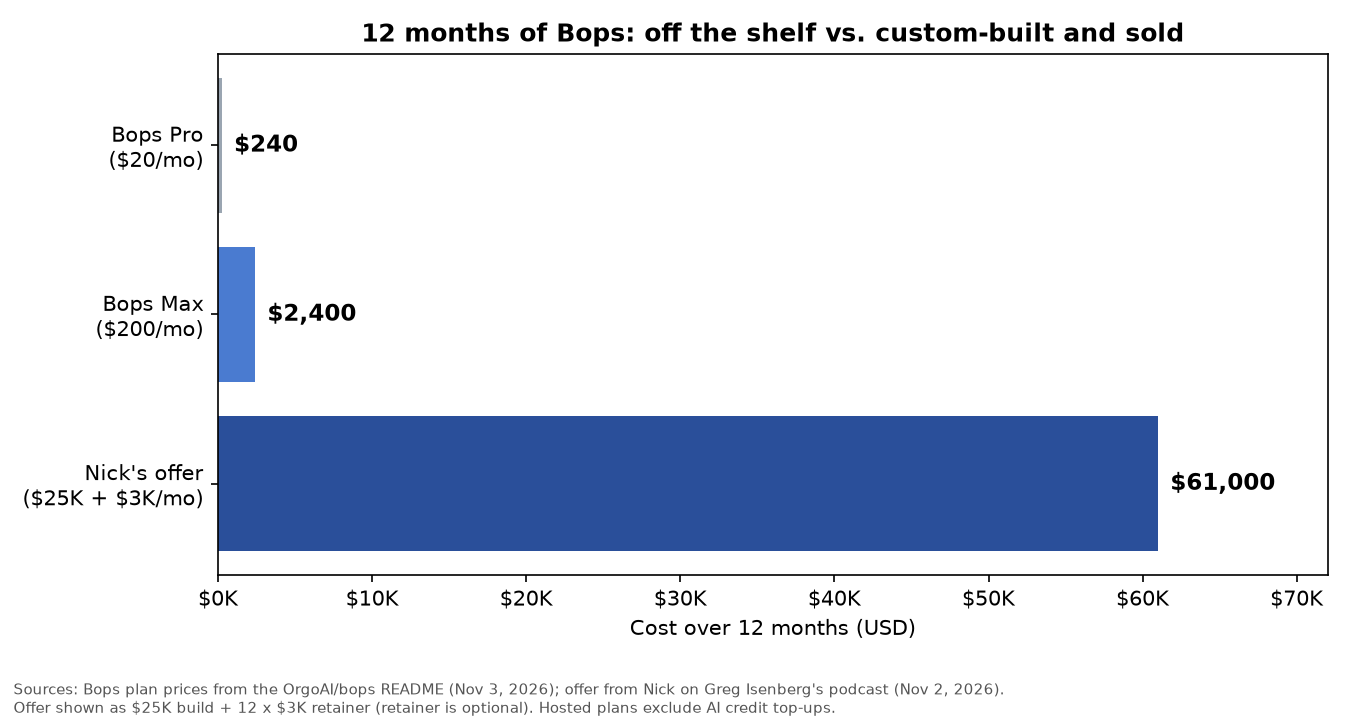
That gap is not a scam. It’s the honest answer to what the owner is buying. It isn’t software. Software, as Greg put it on the show, is trending toward zero. The owner is paying for three things the software can’t do for itself: someone who works out which job is worth handing over, someone who does the setup, and someone who keeps it running next month.
Nick knows this. His own process is the best part of the episode. Sit with the first client, have them share their screen, and watch them make an invoice by hand. You will see the automations, he says. That’s the work. The bots are the delivery.
One more thing before you fork Bops and sell it. Nick says go fork it, customize it and sell it. The repo is under the Functional Source License, and its own plain-English summary says you can’t offer a hosted Bops or “sell an app that does what Bops does” until a version turns two. Read that before you put a dental clinic on a branded fork.
Fifteen bots is the demo trap#
Last week I wrote that nobody on Main Street wants an AI agent. They want the phone to ring. Fifteen bots with fifteen phone numbers is the agent demo again, just bigger.
Here’s what one of my clients actually needed. Saiko Matcha is a matcha shop in Prague that sells online through Shopify. The team ran the store fine. Marketing was the part they didn’t want to do, or didn’t know how to do, and campaigns and the newsletter kept slipping.
So at Othermind we built them one agent, connected to their Shopify store. They ask it about sales and get notifications without opening the store admin. It puts together a sales report, gathers market research for upcoming campaigns, and drafts replies to customer questions for the team to check. It reads ahead to each holiday season, plans a campaign and prepares the newsletter. Nothing goes out until the team has reviewed it and told the agent to send it.
That’s not fifteen employees. It’s one job nobody on the team wanted, done every season. Their words: “It’s like having the marketing specialist we never had.”
The front-desk math also hides a problem. An owner who hears “this replaces a $60,000 salary” starts judging the agent like a hire. Then the first wrong reply to a customer feels like a fireable offense. An agent that drafts and waits for approval is judged on whether it saved the team an afternoon. That’s an easier bar to clear and a more honest one.
The retainer is the product#
The most interesting thing Nick said was about friction. Selling agents at a monthly price, he’s seen owners not want to feel “held by the neck on a retainer.” So he flips it: a big build fee, you own the system, and the $3,000 a month after a 30-day implementation is optional.
I get why that sells. I don’t think it describes how agents age. A website you own stays roughly the same for years. An agent sits on a model, a hosting bill, a set of logins and someone else’s API, and every one of those moves. Shopify changes something. A model gets swapped. A season comes around that needs a new campaign. “You own it” is true on day 31. By month six, ownership without upkeep means a system nobody at the business can fix.
At Othermind we do it the other way round. The first call is free and you get a quote after it. One monthly fee covers the hosting, the AI subscription, support, and improvements as the business changes. That isn’t a better business model in general. It’s just the one that matches what breaks. If you sell the Nick version, price the retainer like it’s the real product, because for the owner it is.
What to copy from the episode#
Plenty. Nick’s niche advice is the most practical I’ve heard on this show. Don’t pick an industry first. Go through your phone, call the 50 people you know who run or work high up in a business, and see who bites. His first niche turned out to be promotional products, an industry he didn’t know existed. Do the first one free for a case study. Greg adds a good twist: ask for three intros to peers if it works, so every next call is warm.
Where I’d change it: don’t lead with fifteen bots or a salary you’re replacing. Find the one job that keeps slipping, build an agent for that, have a person approve what goes out, and charge for keeping it working. The $25,000 might be the right number for some businesses. A matcha shop in Prague doesn’t need fifteen employees. It needs the newsletter to go out before the holidays.