Sell the booked job, not the agent#
Greg Isenberg sat down with James Dickerson, better known as The Boring Marketer, for a 44-minute playbook on selling AI into Main Street. Dickerson co-owns Diesel Dudes, a mobile diesel repair shop in the Carolinas, and spent years running agencies for local businesses. His thesis is blunt: the money is not in pitching “AI agents” to San Francisco. It is in fixing the leaks that keep a plumber’s paid traffic from becoming a booked job.
I build and host agents for small businesses, so I watched this with a bias. The part that stuck was not a new stack. It was the packaging. Nobody on Main Street is shopping for an agent. They are shopping for the phone to ring.
The market is real. The “AI” pitch is not.#
Start with who can pay. The Bureau of Labor Statistics counts about 124,000 private plumbing and HVAC contractor establishments in the U.S. in 2025 (NAICS 23822). The 2022 Economic Census puts average receipts for those employer shops at about $2.6 million a year. That is Dickerson’s sweet spot: local businesses doing real revenue, already spending on ads, whose websites still lose the traffic they paid for.
Adoption of AI inside those shops is still thin where it counts. ServiceTitan’s 2026 State of AI in the Trades (surveyed late 2025) found only 12% of contractors had embedded AI into their processes. Another third were experimenting. The rest were waiting or uninterested. That gap is the opportunity, but only if you stop leading with the technology.
Leads are expensive enough that a small conversion lift pays for the work. LocaliQ’s 2025 home-services search-ad benchmarks put the median cost per lead at $129.02 for plumbing and the same for heating and furnaces, from more than 3,200 U.S. Google and Microsoft campaigns between April 2024 and March 2025. Air conditioning sat at $127.74. The category median across home services was $90.92. Roofing was $228.
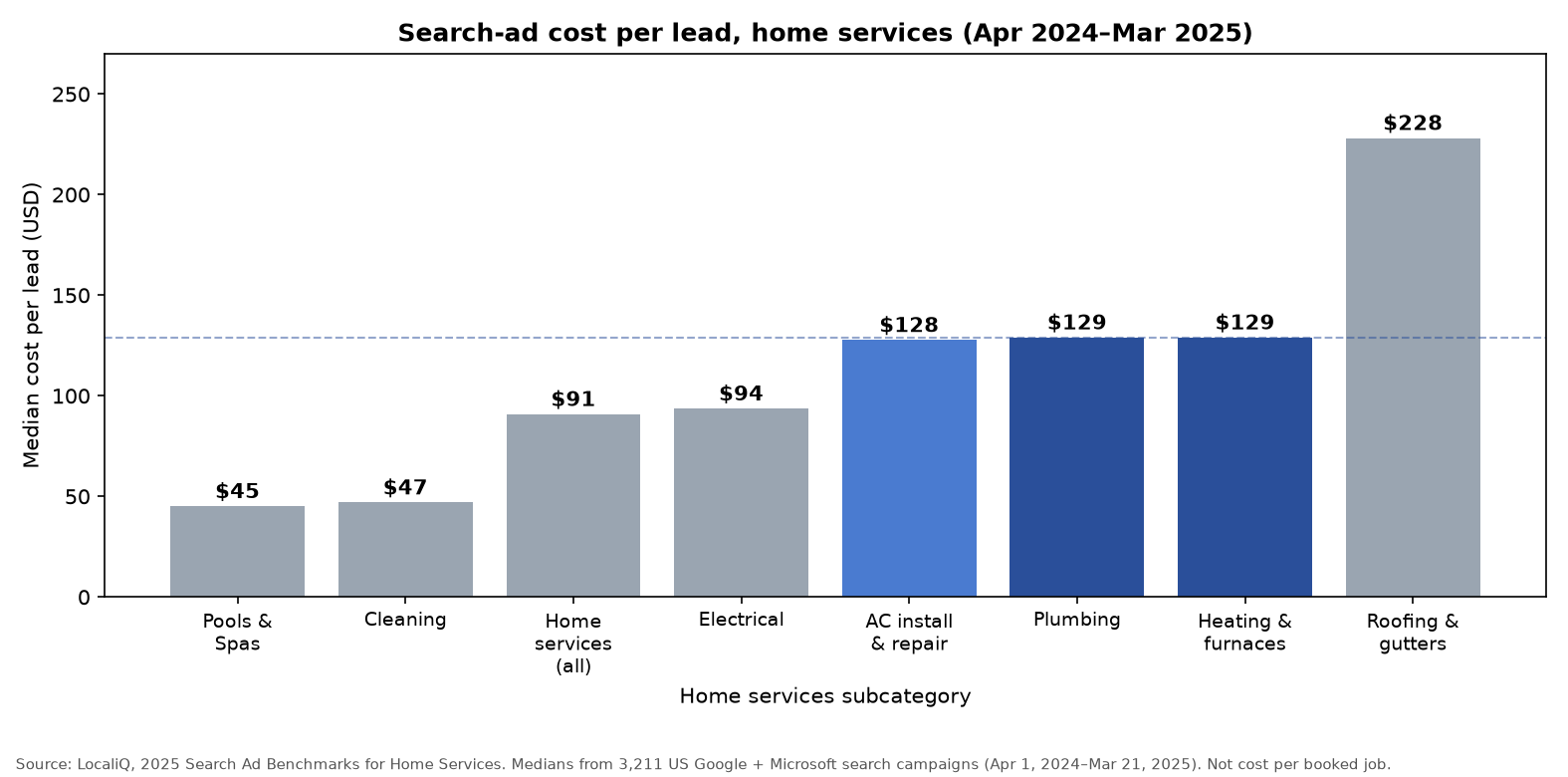
Dickerson walks the math the way an owner hears it. At $129 a lead, 100 leads a month is about $13,000. If the landing page loses roughly a fifth of that traffic before a booking, a few thousand dollars a month walks out the door. One mid-ticket plumbing job can cover a dozen of those leads. You do not need a vision deck. You need a page that books.
What he actually sells#
His rule is simple, and I think it is the whole episode: do not sell AI automation, do not sell agents, talk about booked jobs and more phone calls. “Customers don’t care about any of that. They care about revenue. They care about ROI.” A lot of owners still hear “agent” and picture a real estate agent. Plenty of Main Street America also has a sour taste about AI for reasons that have nothing to do with your demo. Leading with the label puts you on the wrong side of that.
He tested the fashionable product too. An AI voice receptionist for his own diesel shop produced voicemails asking “is this a dumb AI thing?” before people hung up. That is one owner’s sample, not a market study, but it matches what I see when a tool announces itself as AI before it solves a job. The customer wanted a human on the line. The tech was fine. The promise was wrong.
The pitch that works, in his framing, is funnel work aimed at shops already buying ads. Find the leak. Show it visually. Rebuild the path from ad click to booked job. He names the classic patterns: a low-ticket tripwire (the $79 HVAC tuneup), an instant price tool, a repair-or-replace quiz that lands on a video from the owner, then SMS and email follow-up. Agencies still charge serious money for that kind of build. Coding agents make the production cheaper. The scarce skill is knowing what to build and how to talk about it.
The leaks are sitting in plain sight#
Dickerson ran his own tools against Dallas plumbers rated 4.8 or 4.9 who were running Google ads that week. In his sample, four of five landing pages did not repeat the ad’s promise, three of five hid their Google rating, and four of five made you scroll past three screens before you could book. Treat that as his audit, not a national study. Even as a sample, it is useful. Congruency between ad and page, social proof above the fold, and a book button that does not require a scavenger hunt are not AI features. They are the difference between a $129 lead and a job.
He is also picky about niche. Skip lawn care and restaurants. Prefer high-ticket urgent work: plumbing, HVAC, commercial hood cleaning, septic, crawl space, sport courts, backup generators. The Dream 100 from Chet Holmes still applies. Build a short list, research each shop hard, add value for months, and show up in person. Lumpy mail with a brass fitting and a rebuilt page is his example of old-school plus new-school. Meta ads that teach plumbers something useful, without begging for a demo, are the digital version of the same play.
What I am taking from this#
I ship agents through Othermind. The temptation, every week, is to demo the agent. Dickerson is a useful brake. The buyer is buying booked jobs, answered phones, and a funnel that does not throw away the ads they already pay for. The agent is how you deliver that cheaper and faster. It is not the product name on the invoice.
So if you are packaging AI for Main Street this quarter, rename the offer around the outcome. “We turn the traffic you already buy into more booked jobs” beats “we deploy an AI agent stack.” Prove it on one shop for a case study before you charge. Measure call volume and booked jobs, not tokens. And if a voice bot makes customers hang up, kill the bot. The phone ringing is the metric. Everything else is costume.