The number that went viral#
On October 7, Peter Piekarczyk posted that Lauren Tan, the Cursor engineer known as poteto and the author of the pstack plugin, had burned 1.5 trillion tokens in 30 days. Her Cursor profile is public, so the token count was real. The bill was the leap. He assumed an average of $8 per million tokens, got $384K a day, about $11M a month, and $132M a year. The post passed 470,000 views.
Sentry co-founder David Cramer quoted it with the line that stuck: “this is what folks at the labs often dont understand - pay for your own tokens.” He added that it was no slight on poteto.
Theo spent 36 minutes this week on why the number is wrong and why the part nobody priced in is the part that matters. I run Othermind, which builds and hosts agents for small businesses, and I quote token costs to clients who have never seen a token. So I reran the math myself.
Why $8 per million is the wrong input#
A token count on a profile is one big number. A bill is four different numbers: fresh input, output, cache writes, and cache reads. They are priced nothing alike.
Long agent runs reread the same context over and over, so most of what they consume is cache reads. On Claude Opus 5.5, Anthropic’s own pricing page puts a cache hit at 5% of the input price, $0.20 per million tokens against $4 for fresh input. Piekarczyk said he got to $8 by blending input and output prices. That skips the line item that dominates agent work. A community note on the original post made the same point.
Theo checked his own account. In his reply, 33.5 billion tokens of mostly Opus and GPT-6 Astra usage came out to $0.56 per million. That is a heavy user on expensive models, paying retail.
Run 1.5 trillion tokens through his rate and you get about $840,000 for the month. That is a lot of money. It is also about 13x less than the viral figure. Theo argues Cursor almost certainly pays well under retail and that Lauren’s long runs hit cache even harder than his. At the 10 to 20 cents per million he guesses at, the month lands between $150,000 and $300,000. Those are his estimates, not disclosed numbers. Nobody outside Cursor knows the real rate.
To be fair to Piekarczyk, he hedged in his own follow-ups, floating a 10x discount and then a 100x one, which brought his estimate to roughly $1M and then $100K a month. The headline traveled. The hedges did not.
One more check: her profile this morning shows about 1.3 trillion tokens over the latest 30 days. The usage is real and it has not stopped. The open question was always the price per token, and that price is the thing moving fastest.
The part that matters: price at a fixed level of intelligence#
Theo’s bigger argument is about the curve, not the bill. Hold capability constant and track what it costs to reach it. Per Artificial Analysis, which runs every model through the same benchmark suite and records what each task costs at list prices, that number is falling faster than most people pricing AI work have absorbed.
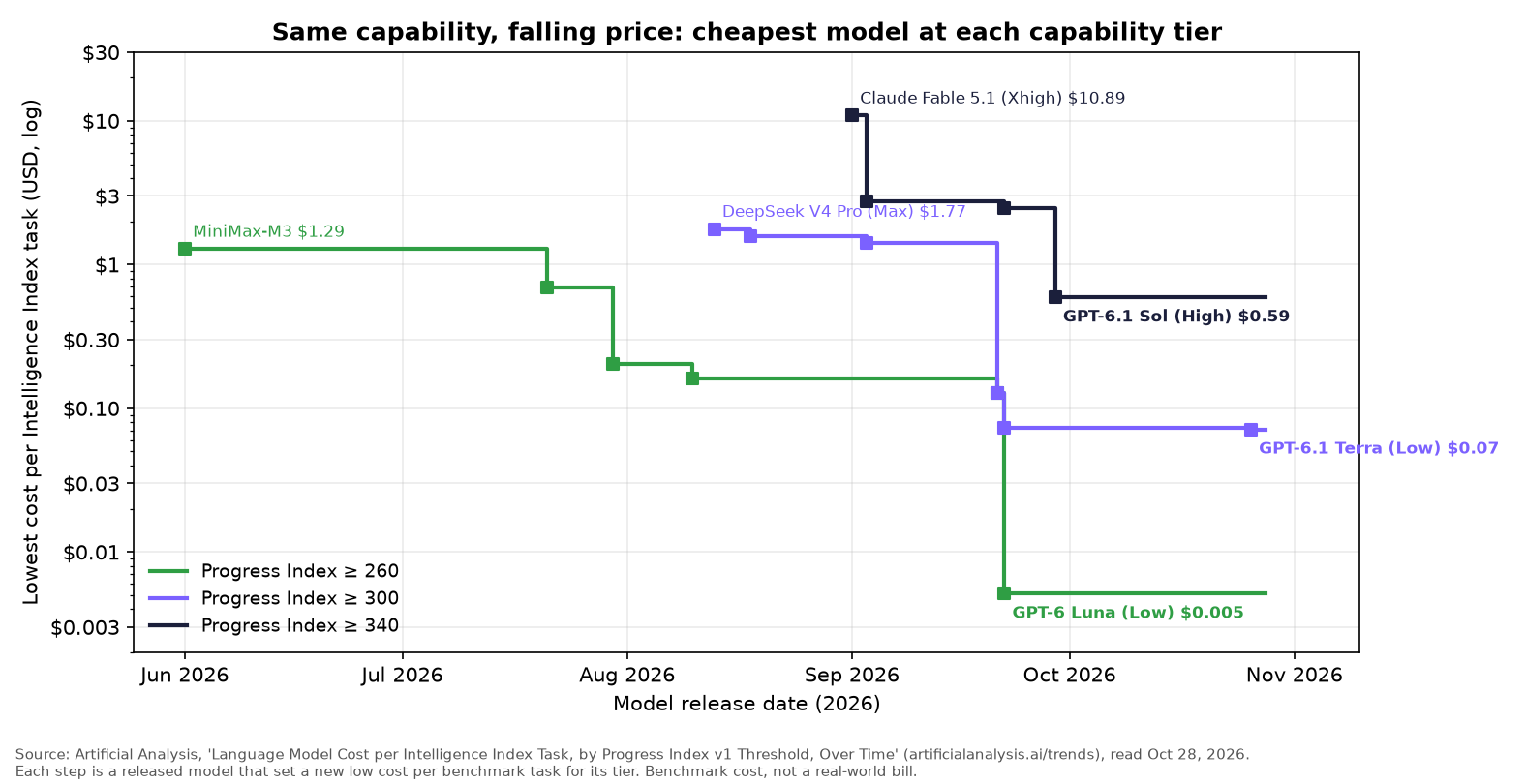
Here is what Artificial Analysis shows right now, using its Progress Index tiers:
- At the top tier (340 and up), the cheapest qualifying model went from $10.89 a task with Claude Fable 5.1 on September 1 to $0.59 with GPT-6.1 Sol on September 29. That is about 18x in four weeks.
- One tier down (320 and up), GLM-5.3 at $5.01 in mid-August gave way to GPT-6.1 Sol’s low setting at $0.16 six weeks later. About 31x.
- At 300 and up, DeepSeek V4 Pro’s $1.77 on August 13 fell to about $0.07 with GPT-6 Luna on September 22.
- At the entry tier (260 and up), $1.29 with MiniMax-M3 on June 1 fell to about half a cent with GPT-6 Luna’s low setting in September. Roughly 250x in under four months.
Theo cites older readings of the same chart, such as the Sonnet 4.5 tier falling from 56 cents a task to under half a cent within a year. Artificial Analysis has since moved to a new index, so I could not reproduce those exact figures, and I would not lean on them. The current data makes his point anyway. In his words, intelligence is “getting cheaper faster.”
The caveat is real: these are benchmark tasks, not your workload. Cramer’s broader objection, that benchmark savings do not show up one-for-one in real bills, has something to it. Real bills go up because we keep reaching for the smartest model and hand it more of the work. That is a choice about what to buy, not evidence that capability is getting more expensive.
Why spend big on frontier models now#
Read Lauren’s spend through that curve and it stops looking like waste. Theo’s framing is that she is exploring what happens when you ignore the cost of intelligence, because whatever she runs today at frontier prices will be cheap in a year. “That $10m in tokens is going to cost $10,000 in a year or two,” he wrote. That is a forecast, not a fact, but it is the same bet the whole industry is making.
It is also not a template. Theo is explicit that nobody is claiming her usage is normal. As he tells it, she works on the product, and her runs double as product research and feedback. A small business should not copy the spend. It should copy the reasoning.
What this means if you price AI work#
This is the part I care about for Othermind and for Scrutoire client work, where I am still chasing the first paying customers.
Do not price on tokens. If a client’s invoice tracks your model bill, every price cut on the curve above becomes a discount you hand over or a margin you have to explain. Price the outcome: the answered call, the booked appointment, the report delivered.
Build on the frontier, then step down. Get an agent working on the smartest model you can afford, so you know the task is solvable. Then rerun the same eval on cheaper models every month. On this curve, the model that matches your frontier build often shows up within weeks.
Quote with a falling cost assumption, but do not bank it. Hosting costs, tool calls, and the VM the agent runs on do not fall at the same speed. Theo even suggests the machine running the agent could soon cost more than the inference. Budget for that.
Check the viral numbers. A single profile stat turned into a $132M headline because nobody split the token types. Before you repeat a scary AI cost, ask what the tokens were and what each kind costs.
The $132M bill never existed. The price collapse does, and it is the number that should be on your pricing sheet.