Credit: this is my take on Marvell Could 4X as the Next Phase of the AI Boom Begins, a 15-minute Milk Road Stocks clip released October 17, 2026, with analyst Melvin and host LG. Milk Road says the clip is taken from a longer episode it published earlier, recorded the day after Marvell’s investor day. Quotes are theirs. The opinions are mine.
Video: Milk Road Stocks. Released October 17, 2026.
The short version#
On October 6, Marvell told investors it expects about $20 billion in revenue in fiscal 2028, up from the $18 billion it guided in August, and laid out a path to $70 to $90 billion by fiscal 2031. It also said the market it can sell into will be about $400 billion by 2030, four times its last estimate.
The stock closed at $287.01 that day. On Friday, October 16, it closed at $227.83. That’s roughly 21% lower in eight trading sessions, while the plan stayed exactly the same.
Milk Road Stocks reran its Marvell segment this week anyway, and I think that’s the right call. The clip is the clearest explanation I’ve seen of what Marvell actually does. The price action is the clearest lesson in what a big target is worth when money gets more expensive.
What Marvell actually sells#
Melvin’s one-line answer is the best one: Marvell builds the plumbing inside an AI data center. Nvidia sells the chips that do the math. Marvell sells much of what lets thousands of those chips, racks and buildings talk to each other: optical DSPs, drivers, switches, cables, custom silicon.
That matters because a GPU waiting on data is a very expensive heater. CEO Matt Murphy put it plainly on stage: “Efficient data movement is becoming a fundamental constraint on AI infrastructure.” His argument is that reasoning models, agents and inference at scale move more data between chips than older workloads did, so every new accelerator pulls in more ports, more switches and more optical links.
Marvell sorts this by distance:
- Scale in: links inside the chip package, down to about 10 centimeters.
- Scale up: chips inside a rack or group of racks talking as one machine.
- Scale out: racks talking across the data center.
- Scale across: separate data centers, up to about 1,000 km apart.
The interesting one is scale up. Marvell says links inside the rack are still mostly copper today, and that copper can’t keep up as speeds rise. If those links move to optics, that’s a market Marvell says it has almost no revenue in yet and expects to ramp starting next year.
By Marvell’s own split, about 70% of its fiscal 2026 revenue came from connectivity and about 30% from compute. This is a networking company that also does custom chips, not the other way around.
The numbers they put on the board#
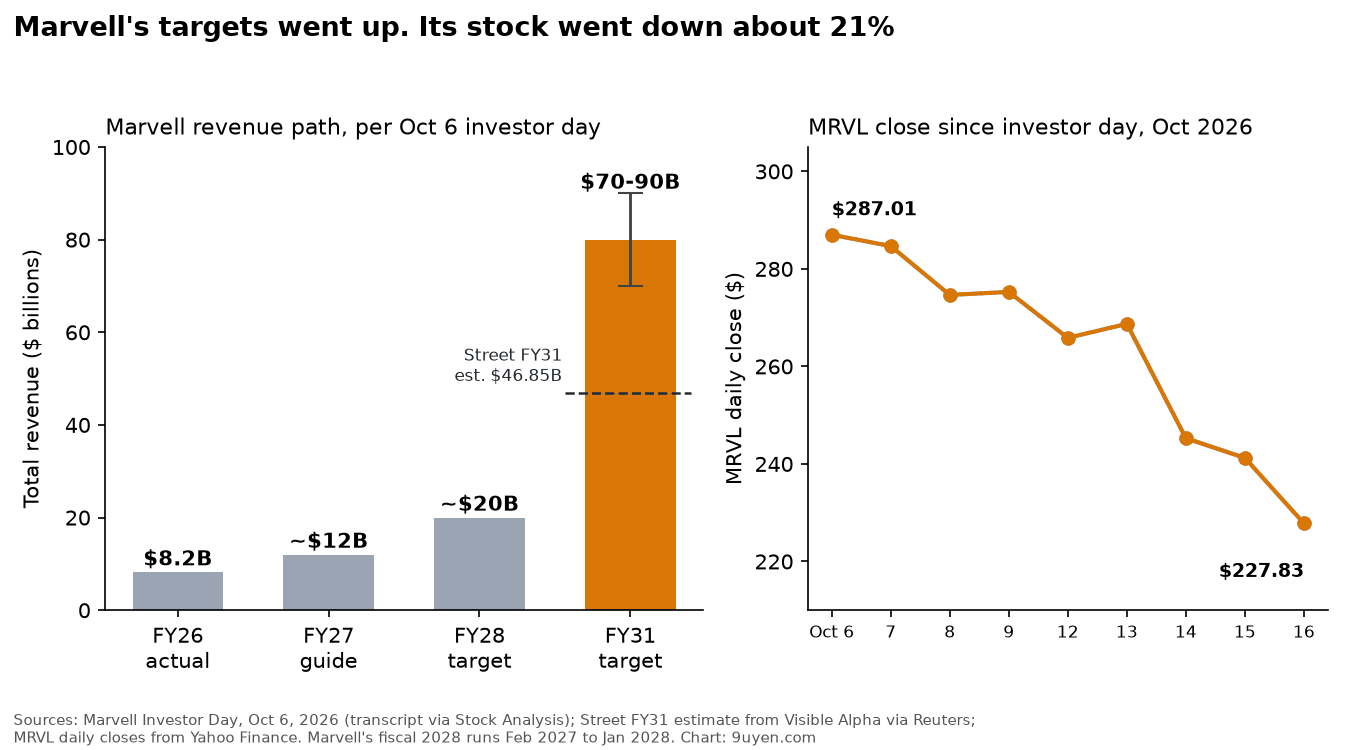
Fiscal 2026 revenue was $8.2 billion. Marvell expects about $12 billion this year, about $20 billion in fiscal 2028 (February 2027 to January 2028), and $70 to $90 billion in fiscal 2031. The midpoint, $80 billion, is about 10x in five years.
For scale, Reuters reported analysts polled by Visible Alpha had fiscal 2031 at $46.85 billion. Marvell’s midpoint is roughly 70% above that.
The market sizing underneath, per Murphy:
- Custom chips: about $235 billion by 2030, growing about 55% a year.
- Switching and storage: about $85 billion, about 40% a year.
- Interconnect: about $65 billion, about 65% a year, the fastest of the group.
There are real contracts behind some of this. COO Chris Koopmans pointed to deals with AWS, Nvidia and Google, the last one described as a $120 billion opportunity over six and a half years for custom products tied to Google’s TPU systems. Nvidia also committed $2 billion to Marvell earlier this year, per CNBC. And Jensen Huang called Marvell the “next trillion-dollar company” at Computex in June. The stock rose 32.52% that day, its biggest one-day gain ever.
So why is the stock down?#
Not because of anything Marvell said. On October 14, September CPI came in at 3.7%, bets on another Fed hike jumped, and the whole AI build-out sold off. CoreWeave, Nebius, Oracle, Dell and HPE all got hit. Marvell fell 8.7% that day, per MarketBeat.
Here’s the part the clip doesn’t get to. Every number in Marvell’s plan sits on one assumption, and Murphy said it out loud: total data center spending reaching roughly $3 trillion by 2030, growing about 35% a year. LG raised the same thing in the clip: this all depends on data centers continuing to get built. Melvin’s answer was that so many projects are already in the pipeline that Marvell can be huge even if new ones stop.
Maybe. But a lot of that pipeline is financed with debt, and debt is exactly what the market is repricing right now. Broadcom CEO Hock Tan has made the same point, per Yahoo Finance: the cost of financing may become a real limit on AI growth. When borrowing gets expensive, the projects at the margin get delayed first, and a supplier priced for 55% to 70% annual growth feels that before anyone else.
That’s the whole tension in one stock. The physics case for Marvell is strong. Its value still depends on someone else’s ability to borrow.
My take#
I’d separate two questions people keep blending together.
Is connectivity the next bottleneck? I think yes, and that’s the best part of the clip. Compute got all the attention for three years. The next fight is moving data between all that compute without wasting power, and Marvell has products at every distance.
Is the stock a buy because of that? That’s a different question. A $70 to $90 billion target five years out is a plan, not a backlog. Even the bottom of the range assumes data center revenue grows 55% a year from fiscal 2028 to 2031, after roughly 70% a year before that. Marvell’s model already has capex growth slowing. If it slows faster, the target moves, and the stock moves first.
What I’d watch, in order:
- The next earnings report. Does fiscal 2028 still say about $20 billion after a month of higher rates?
- The next round of hyperscaler earnings. Marvell’s plan is mostly the top four US cloud companies. Their spending guidance is Marvell’s guidance.
- Scale-up optics revenue starting next year. That’s the new market. If it shows up on time, the copper-to-optics story is real. If it slips, the 2031 number is mostly hope.
Per LG, Melvin bought four times between late June and mid-July, at $269, $230, $207 and $186. He’s well in profit, and fair play. If you’re looking at it now, after a 21% drop in eight sessions, just know that a lower price didn’t make the target any closer. It only made the bet cheaper.
Sources#
- Milk Road Stocks: Marvell Could 4X as the Next Phase of the AI Boom Begins (video)
- Marvell: Investor Day 2026 transcript (via Stock Analysis)
- Reuters: Marvell raises 2028 revenue forecast, AI infrastructure firms slump as rate hike bets rise
- CNBC: Marvell jumps on Huang’s trillion-dollar call
- CNN: AI stocks drop after hot inflation report
- MarketBeat: Marvell shares down 8.7%
- Yahoo Finance: Hock Tan on AI financing, MRVL price history