Quick pulse for Wednesday, November 4. Democrats won both chambers of Congress overnight. Nasdaq futures slid on the news because the AI trade now has a political problem. Local voters backed limits on data centers almost everywhere they were asked. AMD says AI demand is still climbing. Anthropic told future shareholders its own AI may soon speed up its research enough to trip its safety policy.
The blue sweep lands on the AI trade#
Democrats won control of the House on top of the Senate, per AP. The Senate flips ran through Texas, Iowa, Ohio, Maine, North Carolina, South Carolina and Kansas, per the BBC. Kansas had not sent a Democrat to the Senate since 1932. In Texas, Gina Hinojosa beat Gov. Greg Abbott, per NBC News.
Markets read it as an AI story:
- Futures. Nasdaq 100 futures fell as much as 2.5% as results came in, then recovered some, per NBC News. The index had already entered a correction on Monday.
- JPMorgan. Its analysts warned of an “AI sell-off on assumed higher regulation”: possible data-center restrictions and higher taxes on companies and top earners. They also flagged “investigation risk” for CEOs close to Trump.
- Evercore’s Sarah Bianchi called it a “blue tsunami.” Her point: new Democratic governors in Texas, Ohio and Georgia, states with a big share of the US project pipeline, mean “new pauses and restrictions on data center development.”
- Musk on X: “Data centers in space looking pretty appealing right now.”
UBS had already priced in the debate. In Tuesday’s note it said AI infrastructure demand “remains exceptionally strong” and that broad federal limits would face legislative and presidential constraints. State and local rules matter more for where and when data centers get built. Its advice: don’t bet the portfolio on a binary political result.
Voters said no to data centers, almost everywhere#
The local results are the sharper signal. By late Tuesday, 33 ballot measures to restrict data centers had passed or were leading, per Stateline, citing the tracker Data Centers on the Ballot. About a dozen more were still counting. Only one result, in North Dakota, went the builders’ way.
Ballotpedia counted 41 data-center measures on Tuesday’s ballot in 10 states, most of them in Ohio. They ranged from outright bans to six-month moratoriums, power caps and votes required before construction. In an NBC exit poll, 56% of voters said AI and data centers were a “crucial or major factor” in their vote for Congress, per Stateline.
InvestAnswers called this one before the vote. In his “Midterm Rotation to Safety” post he flagged the risk of tougher AI and data-center oversight under a Democratic House, plus debt-limit fights. His view: selloffs before midterms are historically normal and rallies tend to follow. He also expects weak jobs data this week, which would keep the Fed from hiking. He is nibbling after a big SPCX buy on Friday, and has put only about a quarter of his STRC sale proceeds back to work. The 10-year Treasury closed Tuesday at 4.95%, per Treasury data.
AMD says the demand is still there#
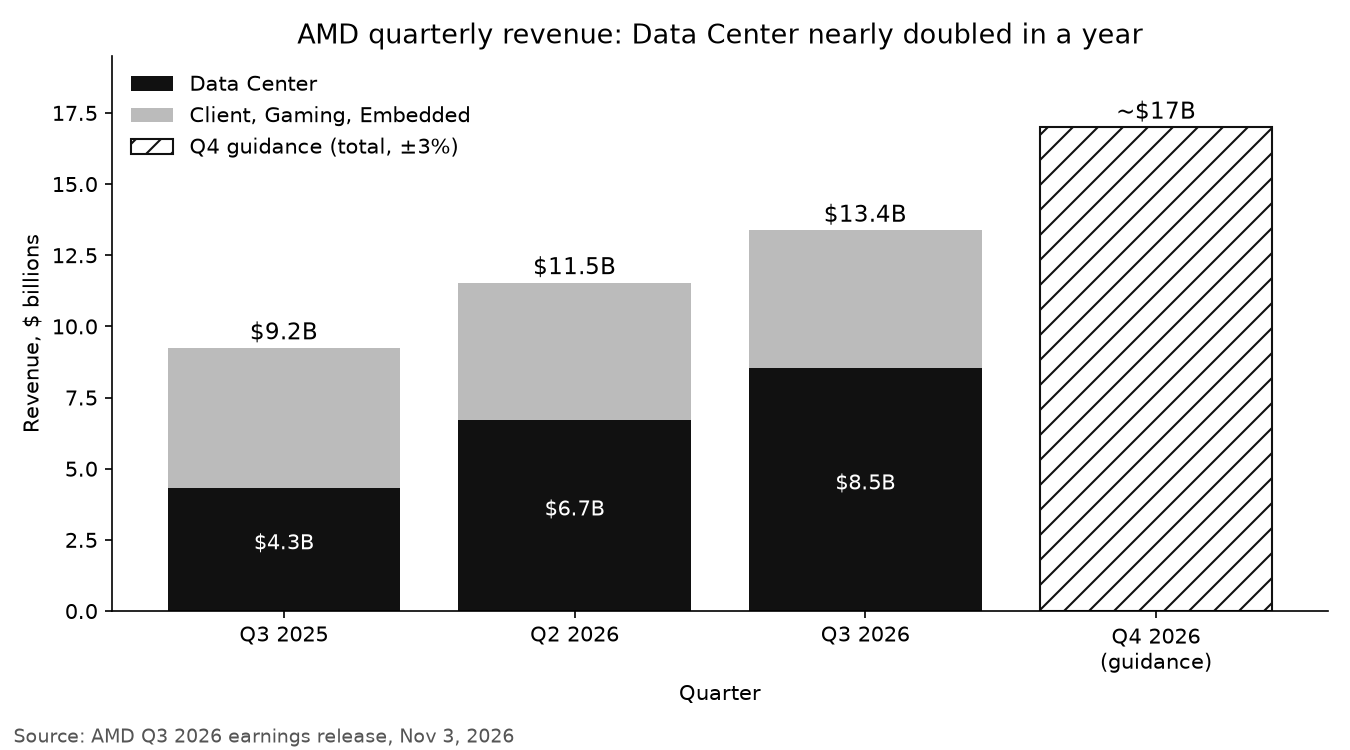
Source: AMD Q3 2026 earnings release.
While politics hit the AI trade, the chip numbers went the other way. AMD reported after Tuesday’s close:
- $13.4B revenue, up 45%. A record.
- $8.5B from Data Center, up 97%, on Instinct MI450 GPUs and EPYC CPUs.
- $2.09 adjusted EPS, up 74%.
- Q4 guidance: about $17B, plus or minus 3%. That’s about 66% growth from a year ago.
Anthropic, Meta, Microsoft, OpenAI and Oracle are already running workloads on AMD’s first Helios racks, the company says. Shares jumped after hours. Context: chip stocks have lost about $3.7T in value since Oct 6, per Yahoo Finance via Superintelligence. AMD is the first big test since that rout and since the vote.
Anthropic says its AI may soon speed up its own research#
Anthropic’s amended IPO filing, dated Nov 2, carries Q3 numbers and a new risk factor.
- Revenue: about $17B in Q3, up roughly 1,127% from a year earlier, per CNBC. Growth is slowing: 47% quarter on quarter, after 144% in Q2.
- Net loss: $23.29B in Q3.
- Commitments: about $895.4B in purchase and lease deals, “substantially all” for compute and infrastructure.
The new line: estimates for future models, “rather than our current models,” indicate it “may imminently meet” its Responsible Scaling Policy definition of “dramatically accelerated progress attributable to AI.” No current model has crossed it. Anthropic also admits it has spotted past speedups only after they happened, and says it is considering policy changes to keep humans in control of frontier model development.
The same day, MIT researchers showed what AI working on AI can look like. They had OpenAI’s GPT-6 Astra find a looping fault inside a small Qwen model and fix it by editing 0.016% of its weights directly, with no training. Its MATH-500 score went from 7.9% to 48.1%. One limit they’re upfront about: on a Gemma model without that fault, Astra’s edits added nothing. Removing a hidden bug is not the same as adding a skill.
Oil shrugged off a US strike on Iran#
The US struck Iran’s Qeshm Island overnight into Tuesday. A US official said it targeted surface-to-air missiles, and another said the strikes looked limited, per Reuters. A senior Iranian official said a deal is still far off.
Oil fell anyway. Brent settled down 1% at $103.60, its lowest close since Oct 7. WTI ended at $96.09. Traders are betting on Qatar’s mediation. ING’s take: “probably too early to think escalation risks have passed.” AP named the Iran war, alongside high prices, as one of the frustrations voters took to the polls.
Quick hits#
- Coinbase. Trading revenue fell 44% in Q3, per Milk Road. Subscriptions and services, mostly USDC interest, brought in $570M, now 49% of net revenue. Morgan Stanley cut COIN to underweight on Monday and slashed its target from $258 to $120.
- Another exchange hack. Brazil’s Mercado Bitcoin lost close to $40M across 10 chains and paused withdrawals, per CoinDesk. It says it will cover all user losses.
Sources#
- AP: Democrats win the US House, taking full control of Congress
- BBC: US 2026 midterms in maps and charts
- NBC News: Stock futures drop as Wall Street confronts the ‘blue tsunami’
- UBS CIO: US midterms put Congress in play
- Stateline: Voters across the country reject data centers
- Ballotpedia: Voters in ten states vote on data center measures
- InvestAnswers: Midterm Rotation to Safety (Patreon)
- US Treasury: Daily par yield curve rates
- AMD: Third quarter 2026 financial results
- Yahoo Finance: The chip rout is spreading
- CNBC: Anthropic reports $17B Q3 revenue in revised S-1
- SEC: Anthropic S-1/A
- Superintelligence: GPT-6 Astra just gene-edited another AI
- MIT CSAIL: Sparks of Weight-Space Programming
- Reuters via Euronext: Oil settles near 4-week low
- Milk Road: What’s carrying Coinbase now?
- CNBC: Morgan Stanley downgrades Coinbase
- CoinDesk: Mercado Bitcoin pledges to cover user losses
- Mando Minutes