Quick pulse for Sunday, November 1. The FBI says North Korea robbed Binance, and Binance is letting money out again this morning. Two AI labs claim to have broken one of computer science’s core assumptions. France’s lower house voted to tax every gigabyte. And Cisco handed its legacy code to a 27-year-old with unlimited AI tokens.
FBI: North Korea did it. Binance reopens withdrawals#
The FBI said Saturday that North Korea’s TraderTraitor unit, the group behind last year’s $1.5B Bybit hack, stole more than $6B from Binance on or about Oct 29. It has seen the hackers converting the loot mostly into ETH. The alert lists over 600 Ethereum addresses, just under 20 Bitcoin addresses and one Solana address, and asks exchanges, DeFi services, swap services and node operators to block them, per CoinDesk.
The laundering is just starting. Chainalysis CEO Jonathan Levin says the attackers already use thousands of addresses and expects “tens of thousands” in the coming weeks: “They have too much money for their trusted laundering venues to handle.”
Binance’s side:
- 95% replaced. About $6B of the $6.3B stolen has been bought back with company money, per Reuters. It was 90% on Saturday. The last 5% is less liquid tokens.
- Where the money came from. Part of the $1B SAFU user-protection fund, part of the Futures Insurance Fund, and the corporate treasury. Co-CEO Yi He said 50% of SAFU would be used and refilled to about $1B.
- Withdrawals are back, in phases. Phase one runs 06:00-09:00 UTC today (08:00-11:00 Helsinki) for 15 assets including BTC, ETH, BNB, SOL, XRP and DOGE. The Bitcoin network opened first. Other tokens follow after checks.
- Reserves. A new snapshot taken 00:00 GMT Saturday should show 1:1 backing for 10 tokens: BTC, ETH, USDT, BNB, SOL, USDC, XRP, USD1, RLUSD and ZEC.
Stablecoin issuers have frozen over $2.4B of the stolen funds, per CoinDesk. Bitcoin sits near $77.5K, ETH near $2,267. Calm, for now. The real test is whether withdrawal queues stay orderly once more tokens open.
Two AI labs say the Exponential Time Hypothesis is false#
On Oct 26, OpenAI posted a paper titled “The Exponential Time Hypothesis is False.” About six hours later Anthropic posted its own, credited to “Claude / Anthropic.” Both date the discovery to Oct 16, and both ship proofs checked in Lean, per Superintelligence.
What ETH says: 3-SAT, the classic yes-or-no logic puzzle, can’t be solved faster than some fixed exponential rate. Researchers have leaned on it for decades. Anthropic counts more than 800 papers that prove at least one result only under ETH or a stronger version. Both labs claim an algorithm whose running time grows more slowly than any fixed exponential.
The details:
- Who did the work. Anthropic says an internal Claude research model found the core algorithm with 14M output tokens and “no human input.” Its paper is 49 pages. OpenAI’s paper names no model and gives no compute figure. OpenAI also claimed two other results the same day, including a proof it says settles the Kakeya conjecture.
- What it doesn’t do. Anthropic’s own paper says the bound doesn’t beat plain exhaustive search unless a formula has more than 10^10,000 variables, and that the result “says nothing about solving formulas in practice.” It doesn’t touch P vs NP.
- “Checked in Lean” has limits. Lean checks the proof against the formal statement. Whether that statement really says “ETH is false” still takes humans. OpenAI’s Lean theorem covers a weaker bound than its paper, per an independent review at SXZ.io.
- Review is just starting. Russell Impagliazzo and Ramamohan Paturi, who proposed ETH, are organizing a public review with Ryan Williams. They wrote that “our involvement should not be taken as certification of the claim.”
The bigger point from Superintelligence: the proofs are public, but the models that found them are not. Two companies now decide when frontier math results drop and who sees them first.
France votes to tax every gigabyte#
France’s National Assembly adopted amendment I-1358 on Friday: €0.055 per GB of data sent to French internet subscribers, paid by the sender. That means Netflix, Google, Meta, cloud and game services, not households or ISPs. The vote was 11 to 10, against the government’s advice, per Numerama. Socialist deputy Laurent Lhardit wrote it and says it would raise €10B a year. The government hasn’t backed that number.
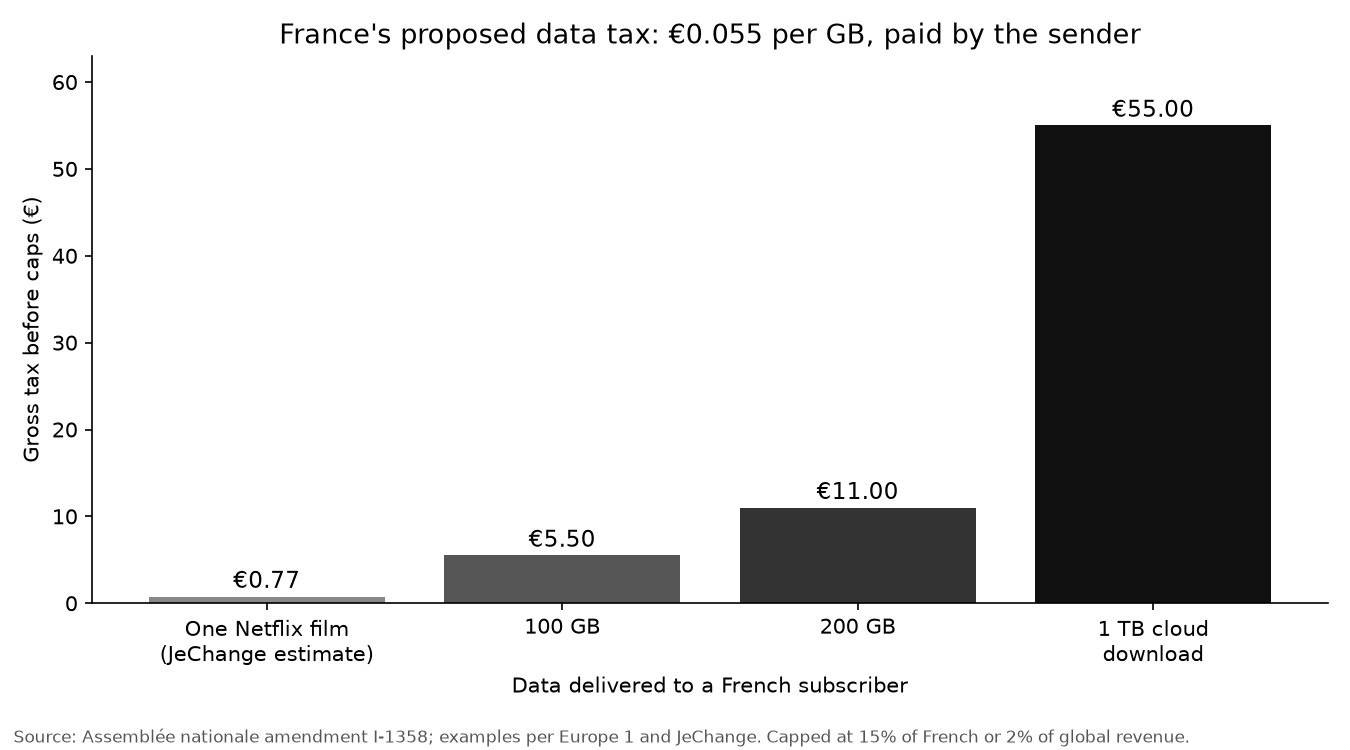
Source: Assemblée nationale amendment I-1358; examples per Europe 1 and JeChange.
ISPs would count the traffic per sender and report it quarterly to the tax office. The bill is capped at 15% of French revenue or 2% of global revenue. It isn’t law yet. It sits inside the 2027 budget bill, which still goes to the Senate and can be cut.
The levelsio take is blunt: this is where Western and Southern Europe is heading. Regulate business away, talent and money leave, the state runs short and reaches for new taxes. Whatever you think of that, platforms will pass this one on in prices.
AI is splitting the job market in two#
Peter Diamandis put two stories side by side this week. In the New York Times, a 22-year-old biology graduate has applied for 511 jobs. Whole Foods rejected her after an interview run by an AI chatbot called Sage.
Then Fortune: Cisco president Jeetu Patel found Padmanabhan “Paddy” Krishnamurthy, 27, “five levels” below him, “buried away in the organization doing something unstrategic.” Krishnamurthy co-founded EzDubs, which Cisco bought in 2025. He pitched rewriting Cisco’s legacy code with a two-person team. Patel’s answer: “I’ve given him unlimited tokens because he’s going to refactor code. So I’m like, you can go, you can go nuts.” The target is 98% of the legacy code in 24 months, with four weeks to prove it works.
Diamandis’s point: AI is automating the bottom rungs of the career ladder. At the same time, the people who can actually use it get handed huge jobs. Conviction’s Sarah Guo says some big tech companies have only one person who really knows how to use AI at the frontier. The scarce skill is agency.
InvestAnswers: an options rule book from the community#
A quiet IA weekend. Saturday’s Patreon post shares a LEAPS and options rule book that a community member pulled together from years of IA posts and videos. Version 1 is up as a PDF. Version 2 is in progress, and IA plans a simpler edition. No market calls in it. Useful if you trade options the IA way and want the rules in one place.
-Q
Sources#
- FBI cyber alert: North Korea responsible for $6B+ Binance attack
- CoinDesk: FBI confirms North Korea’s role, asks DeFi to block addresses
- Reuters via Investing.com: Binance to resume withdrawals after covering bulk of stolen $6.3B
- NBC News / Reuters: Binance replaced 90% of stolen funds
- TokenPost: Binance resumes withdrawals in phases
- Superintelligence: Two AI Labs Say They Refuted ETH
- OpenAI: The Exponential Time Hypothesis is False (paper)
- Anthropic: A 2^o(n) Time Algorithm for 3-SAT (paper)
- SXZ.io: what the Lean theorems actually promise
- Papex: has the ETH refutation been verified?
- Assemblée nationale: amendment I-1358
- Numerama: the Assembly votes a 5.5-cent per GB tax
- Europe 1: deputies vote a per-gigabyte tax
- JeChange: what the 5.5-cent tax would really change
- levelsio: What is happening in France will happen throughout Western and Southern Europe
- Peter Diamandis: AI Is Creating Two Different Futures for Young People
- Fortune: Cisco lets a 27-year-old refactor 98% of its legacy code
- InvestAnswers on Patreon: Great Options Trading Rule Book